Typically, when a company wants to meet, you expect more of the same --
not a change in strategy, nor a decision to enter an entirely new
product category. So when Razer wanted to meet us one bright, oddly cold
San Franciscan morning last August, we certainly weren't expecting to
meet its CEO, Min-Liang Tan, and we definitely weren't prepared to find a
17-inch prototype laptop, henceforth known as the
Blade.
Shaving puns aside, we listened to Tan proudly wax on about the results
of nearly three years of development, much of which involved recruiting
a bevy of talent from the now-defunct
OQO.
What they'd accomplished, according to Tan, was the "world's first true
gaming portable." An audacious statement, sure, especially considering
the Blade was to be Razer's foray into the PC market. No matter. Tan's
impetus was clear: the outfit would cater to gamers who'd been left in a
vacuum after formerly gaming-obsessed companies sold out, leaving the
segment to languish. His angle, however, would be different. The Blade
wasn't going to be a gaudy, gargantuan, no-holds barred device with
outright performance in mind. No, instead the 0.8-inch thick aluminum
beaut would attempt to straddle the worlds of portability with
performance, seeking to hit a perfectly balanced middle ground.
That sounded reasonable, but judging by reactions from most of you, the
decision to stuff this $2,799 rig with a mid-range GeForce GT 555M card
wasn't. Nor was the call to kit it with a paltry 320GB of rotational
storage. Razer would rectify the latter in
December,
promising 256GB SSDs for all -- a concession that would push shipments
back, well, until now. Still, even after toying with it
briefly at CES,
our impressions were ultimately shallow, as we couldn't get much of a
feel for it in that controlled environment. Which brings us to the
present day, and with Razer graciously airdropping a Blade onto our
doorstep, does this experimental laptop stand up to its maker's gutsy
claims? Or will those who've shelled just shy of three grand be sorely
disappointed with its execution? Well, there's only one way to find out,
and that's to join us past the break.
Look and feel
We
hate using the term, but we will anyway: the Blade is sexy. That's a
grossly overused word, sure, but if we ever really meant it, that time
would be now. The Blade feels premium in a way that's difficult to
quantify, but we're sure it has something to do with that sturdy shell
and relatively thin profile. There's no question in our mind, though,
its inspiration, down to the minutiae, borrows heavily -- and we mean heavily
-- from the 17-inch MacBook Pro. Details like its latchless design,
sunken chiclet keyboard, to the shape of its outer shell down and its
identical hinge. But we're perfectly okay with that, as they've been
remixed into something far more arresting.
That
luxurious experience begins not with the hardware, but the elaborate
packaging. To say we weren't expecting much would be an understatement
-- can you remember the last time you unboxed a PC laptop? -- but how
could you not, with the faux-carbon fiber weave adorning the box above?
Not to mention those gorgeous asymmetrical cut-outs, giving way to a
Razer-green layer beneath, subconsciously begging you to peel it away.
Lifting off the top half reveals an interior dominated by the rather
large laptop, which you'll conveniently lift out with a similarly hued
green ribbon. Underneath, you'll find the usual suspects: a pouch
containing manuals, stickers and so forth, alongside a custom oblong
power brick. So far so good.
To
achieve that relatively thin 0.8-inch profile, Razer's kitted its
offering with a sparser number of ports than you'd find on a traditional
"gamer-focused" machine. On the left side, just past the beefy cooling
vent, there's power, Ethernet, HDMI, three USB ports (one of the 3.0
persuasion, demarcated in green) and a headphone jack. That's it
connectivity-wise, as on the right you'll find another exhaust
(identical in size and placement to its leftward cousin) and a
Kensington lock slot about half way down. It's around this time you
realize the Blade is devoid of an optical drive, so those thinking about
installing games the old-fashioned way better invest in an
external unit or get cozy with a service like Valve's Steam or EA's
Origin. Other exterior highlights worth mentioning are a backlit logo on
the lid, which glows green, and an additional set of chrome-accented
vents festooning the base.
Lift
the lid and you'll see that sparse aesthetic extends onto the laptop's
interior. Which, apart from the already mentioned backlit keyboard and
LCD-stuffed trackpad, is home to a rather large power button, which
glows green when the laptop is powered on, and pulses when the machine's
asleep. The only remaining features crammed onto the deck space are a
speaker grille that runs the entire length of the hinge, and a
chrome-ringed webcam, just north of the screen.
While tastefully
designed and well-built, unfortunately not all is perfect in the land of
the Blade. There's one niggling flaw that taints the otherwise
top-notch experience, and it has to do with difficulties in prying the
latchless notebook open. Either the hinge isn't lubricated enough, or
the front-portion of the system isn't privy to enough mass, but with the
unit shut, attempts to lift the display are met with frustration, as
its bottom (read: computer-housing portion) comes along for the ride.
You eventually adjust to opening it more slowly and with less force, or
by holding the base while you attempt the maneuver -- neither of which,
we think, are satisfactory options for a machine this expensive. It's an
unfortunate oversight (or engineering compromise, perhaps) and our only
real gripe with the hardware, though unfortunately it rears its head
every time you open it.
Keyboard and touchpad
While
the rest of the Blade isn't functionally different from other laptops,
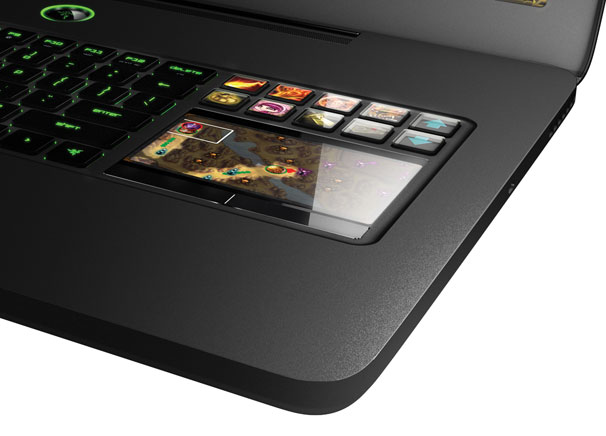
its party piece, the LCD-toting touchpad and the ten configurable
buttons directly above it, are certainly novel. We'll begin with the
mousing device. As best as we can tell, its top-most layer houses a
rather thick layer of tempered plastic, which unfortunately introduces
more friction than we'd like, in addition to the fact that it just
doesn't feel as premium as the rest of the laptop. Although in fairness,
with time (and of course, grease) swipes do become easier. But for what
it lacks in feel, the pad makes up for in accuracy: we found tracking
excellent and can happily report that for once we've got a trackpad that
can actuate two-finger scrolling in a non-frustrating fashion. Like all
PC scrolling, it's linear -- there isn't any spiffy physics-induced
acceleration of content here -- but the Synaptics pad was more than
responsive otherwise. Multitouch also makes an appearance, naturally
making that previous two-finger scrolling endeavor possible, as well as a
few others: like pinch-to-zoom, two-finger rotations and three-finger
swipes which provide a modicum of functionality depending on what app
has focus. Those additional gestures weren't nearly as polished, but
seeing as they're less generally useful, we didn't mind much, except for
the last, which you'll have to be rather deliberate to actuate as you
swap between pre-programmed sets of icons in one mode of trackpad.
But
stuffing a trackpad with an LCD can only get you so far, which is where
the company's Switchblade-UI comes in. After creating or logging into
the company's Synapse service, the ten keys above burst into life. From
the initial screen above, you can use the touchpad as you normally
would, or throw it into one of ten alternative modes -- nine of which
hijack all trackpad mousing functionality altogether (leaving all cursor
control to a dedicated external mouse). Returning to the default mode
is thankfully easy, though, as one hits the dedicated Razer button in
the bottom right corner of the keyboard. We spent most of our time in
the first mode, which is the one you'll want, as this is the only one in
which those delectable ten keys can be configured as you please. To
customize them you'll use the company's Synapse utility, which is where
you can create and save multiple profiles -- a fancy name for groupings
of your button-machinations. Within each profile, you can configure
infinite sets of ten keys, which you'll then swipe between with that
three finger swipe we mentioned earlier.
From Synapse those
buttons can be assigned to mimic any key press, any mouse button, a
pre-recorded macro or alternatively launch a program. Once you've
assigned a function, you can optionally choose an icon (your own, or one
of the company's pre-sets) and voila, you're good to go. While some of
you will no doubt painstakingly go through and create multiple profiles
for all your favorite games, we reveled in primarily using this
functionality as our application launcher. With one-touch access to our
favorite ten programs, and only a swipe away from twenty, we nary had to
touch the Windows taskbar or desktop shortcuts to launch our browser,
Photoshop or whatever game we pleased. It's an
Optimius mini-six mini-ten on our laptop and it's the next best thing since sliced bread.
Believe
it or not, that's only the trackpad's first view. Tapping the Razer key
and returning to its initial screen, the next three options are
widget-y type screens: a numpad, a mode to record macros and a pane to
enable and tweak settings pertaining to "Gaming mode." Following that is
the browser (more on that later,) which also serves as the basis for
the following four: YouTube, Facebook, Twitter and GMail. Apart from
YouTube (which is more customized and gets a custom mapping of buttons),
these all load mobile versions of those sites, which can range from
workable (Twitter), frustrating (Facebook) or pretty much unusable
(GMail). The final and tenth function, is a clock -- something we'd have
loved to use as our trackpad's background (instead of the persistent
Razer logo), but curiously this mode blocks our mousing endeavors,
despite being non-customizable and unresponsive to gestures.
Circling
back to the touchpad's browser, it actually runs a separate process of
Internet Explorer -- the giveaway being the tell-tale clicking sound
effect you'll hear when you tap links. When surfing, the bottom five
keys swap to pertain to navigation, with the last two allowing you to
bringing up URL and search fields which you populate with input from the
keyboard. It's serviceable when you need a walkthrough, but no way to
store bookmarks or change the default homepage, we found it simply
quicker to pull out a smartphone, reach for a tablet, or even use the
Windows key to hop out of a game and open a real desktop browser to find
what we were looking for.
That's unfortunate, because while
stuffing a screen underneath a trackpad sounds like a geek's dream, the
software powering the trackpad is lackluster. In a day and age with
mobile devices housing far richer experiences, there isn't any way
you'll be using the mobile website of Facebook here, over the
purpose-built app on your phone. In our time with it, the trackpad was a
conversation starter, sure, but ultimately the widgets onboard need a
significant investment of time and resources to make them practical
enough for us to recommend them. You could argue that Razer should just
run Android on the touchpad instead, and while that would assuage some
of our concerns, if given the choice, we'd just dump the screen entirely
and put those savings toward a cheaper starting price. Put simply, had
the screen beneath the Blade gone "missing," from prototype to
production, we'd have been just as pleased in our time with it -- keep
the ten customizable buttons above it, though -- those can stay.
When
it came to the keyboard, there was better news, as we've got unwavering
praise for the tactility of the unit on the Blade. We'd have preferred
if the entire deck were shifted a bit northward, allowing for a roomier
palm rest, but now we're just nitpicking, as that chiclet keyboard is
top-notch. As you'd expect, every key is backlit, though for whatever
reason, despite the F-row being backlit, the secondary Fn-based controls
that co-inhabit them, aren't. That sets you up for some inconvenience
when adjusting brightness or volume in low-light, but we'll hazard that
before long you'll have their respective F1-F12 mappings committed to
memory. Lastly, we're told it's anti-ghosted too, which might not have
made a huge difference when typing this review, but certainly caters to
the kind of serious gamers for whom Razer seeks.
Display and sound
If
one piece defines our time with the Blade, it's the gargantuan
17.3-inch display. Defining the unit's massive footprint, the full 1080p
matte panel (1920 x 1080) is a particularly bright spot. Ripe with
color and vibrant from all angles, we had no complaints about the
panel's black levels, contrast or brightness. White balance skews a
little blue, but nothing that couldn't be rectified with some
calibration. Finally, did you hear us say it's matte? Because it is, and
that's your only choice. Kudos, Razer -- death to glossy displays.
As
splendid as its primary display is, our general feeling of
disappointment with secondary LCD found underneath the trackpad
continues. Its certainly not of the same caliber, suffering primarily
from a lack of brightness and poor black levels. Weak contrast aside,
the reflective screen is more squint-inducing than we'd like, rendering
it especially dim in bright environments. We also noticed its tendency
to diagonally shear while displaying fast-paced content -- say like when
rapidly scrolling a webpage, or whilst watching video with fast-paced
action. Seeing as you won't be using it much, neither are deal-breakers,
but we'd hoped for more when we were told it was equivalent to a
smartphone panel. In contrast, the ten programmable keys sitting
directly above (all powered by a separate LCD, we'd imagine), are bright
and delectably tactile as ever.
Which
brings us to the Blade's acoustic performance. Unlike some of its
flashier contemporaries, Razer didn't team up with a speaker
manufacturer to serve up audio on the Blade. Setting aside the question
of whether or not marketing infused tie-ups actually derive better
sound, the unfortunate fact is the audio experience on the Blade is
woefully subpar. Our unit wasn't particularly loud, but more alarming
was the complete dearth of any meaningfully low bass notes. Not unlike
listening to earbuds lying on your desk, the sound lacks any warmth --
which is unacceptable, given that $2,799 price tag. You can ameliorate
the situation slightly by flipping the included Dolby Home Theater
software on, but ultimately software enhancements can only go so far. We
know, serious gamers will use plug in a proper headset, but it's
definitively the weakest area of the Blade -- so bad mind you, we
initially questioned if our unit was faulty.
Performance
|
PCMark Vantage
|
3DMark06
|
| Razer Blade (2.8GHz Core i7-2640M, GeForce GT555M, 8GB) | 14,379 | 11,556 |
| MSI GT683DXR (2.2GHz Core i7-2630QM, GeForce GTX 570M, 16GB) | 7,210 | 16,862 |
| Toshiba Qosmio X775-3DV78 (2.0GHz Core i7-2630QM, GeForce GTX 560M, 8GB) | 7,900 | 15,169 |
| HP Envy 15 (2.4GHz Core i5-2430M, AMD Radeon HD 7690M 1GB) | 7,210 | 8,839 |
| Dell XPS 15z (2.7GHz Core i7-2620M, NVIDIA GeForce GT525M) | 8,023 | 7,317 |
| 15-inch Samsung Series 7 Chronos (2.2GHz Core i7-2675QM, Intel HD 3000 / AMD Radeon HD 6750M 1GB) | 7,824 | 8,891 |
| Sony VAIO SE series (2.4GHz Core i5-2430M, Intel HD Graphics 3000 / AMD Radeon HD 6630M 1GB) | 5,632 | 6,898 |
| 2011 15-inch MacBook Pro (2.2GHz Core i7-2720QM, Radeon HD 6750M / Intel Graphics 3000) | 8,041 | 10,262 |
Despite being tuned for balance, the Blade eked out a rather respective
showing in our usual collection of benchmarks. Armed with a 2.8GHz Core
i7-2640M CPU, it notched a speedy 14,379 in PCMark Vantage. It wasn't
nearly as triumphant in the graphics department, where it was held back
by that GeForce 555M card, which managed 11,556 in 3DMark06 and P1,536
in 3DMark11.
Performance isn't all about raw numbers, though,
and happily the Blade doesn't disappoint in real world use. Throughout
our testing, the Blade was able to handle typical computing tasks
aplomb: heavy web browsing, Photoshop editing and serving as an Engadget
workhorse were all dealt swiftly and without complaint. It's when you
ask the Blade to serve as your gaming compatriot, however, things begin
to get a little murky. While after-work Starcraft II matches
cranked just shy of ultimate posed no problem (with framerates
consistently in the high forties to fifties,) we can't say the same
about newer titles which invoke strain, even after you reel in the
visuals significantly. While playing The Elder Scrolls V: Skyrim, for example, we
reeled graphical settings all the way back to medium to make the game
passably playable -- we're talking frame rates in the high twenties at
full resolution [Update: Fresh drivers from NVIDIA drastically improved performance for Skyrim,
enabling the game to run on the GPU instead of integrated graphics
card. With graphics cranked to high we saw frames hover around high
twenties, and in medium a very playable low forties]. With something
like Battlefield 3 on the other hand, we had more luck, eking out more respectable mid-30FPS from medium settings, again at full resolution.
When it came to heat dissipation, we had no complaints in our time
spent with the Blade. As you'd expect, things get a little toasty while
running full tilt, but even then it won't lacerate, and for general
purposes it kept decently cool. Fans weren't loud obnoxiously loud
either, however, in time you'll notice the fairly aggressive leftward
unit which has a tendency to flare up any time you encounter peaky CPU
work. We weren't particularly dismayed by the behavior, but it's
definitively noticeable, perhaps more so here, as the Blade's SSD makes
it silent otherwise.
Finally, thanks to its aforementioned
reliance on flash storage, loading times, installs and boots were
speedy, with the latter clocking in at 17-18 seconds from a cold start
to the Windows login screen. Running the disk benchmark ATTO informed us
that peak reads happened at 467MB/sec and writes at 362MB/sec. Finally,
we'd like to applaud Razer for making the right choice in delaying
shipment to opt for that SSD -- in 2012 as far as we're concerned, it's a
must-have in a machine in this price range.
Battery life
Laptop
|
Battery Life
|
| Razer Blade | 2:57 |
| MSI GT683DXR | 2:40 |
| Toshiba Qosmio X775-3DV78 | 1:26 |
| 2010 HP Envy 17 | 2:10 |
| HP Envy 15 | 4:07 |
| Dell XPS 15z | 3:41 (Optimus disabled) / 4:26 (Optimus enabled) |
| 15-inch Samsung Series 7 Chronos | 5:47 |
| 2011, 15-inch MacBook Pro | 7:27 |
So we've determined it isn't quite the graphical sprinter, but can the
Blade still come out ahead in the marathon that's battery longevity? In a
word no. As shown above, running Engadget's video-rundown test at
roughly half brightness reveals things are a little more complicated
than you might have initially thought. Yes, the Blade's less power
hungry graphics are primarily responsible for it running circles around
its more pudgy, brute-ish rivals. Still, that's not saying much, as
being just shy of three hours, it falls considerably short when compared
to more mainstream notebooks. Still, that bests MSI's 15-inch GT583DXR
by a full 20 minutes despite wielding a larger screen (but with a lesser
card) and demolishes the more comparable 17-inch Qosmio X775's by a
whopping hour and a half -- all, in a thin profile.
Alas, if
you were planning on a sojourn sans charger, you'll be out of luck. Even
with casual use and exercising brightness restraint, we were only able
to coax just shy of three and a half hours of work out of its 60Wh
battery -- dwindling down to around three with full brightness. For
those daring to game on the go, unlike other laptops which'll
significantly pare down their performance, the Blade will cheerfully run
at full throttle for about an hour before simmering down. Ultimately
neither are legendary, we know, but compared to other laptops,
definitely workable.
Software
Seeing as its exterior is devoid of all stickers -- save for one -- why
would Razer go and mess with its innards? Thankfully it hasn't, leaving
the Blade free of additional software or crapware, with an almost clean
install of Windows 7 Home Premium. And we mean "almost," as you'll
still get Dolby Home Theater software and a copy of Razer's Synapse app
-- the later of which you'll want to configure that those LCD buttons.
The competition
The market for laptops that cost nearly three large is by no means
sprawling, but indulge us for just a moment while we compare the Blade
to other systems that compete in this arena. We'll begin with the
granddaddy of them all, the
Alienware M17x.
Though configurations of that beastly guy start at $1,499, it can be
stuffed with all sorts of doodads, pushing it beyond the Blade's $2,799
price. To match the Blade's price tag, we began with the $1,899 machine
and kitted it with a 2.5GHz Core i7-2860QM, 256GB of solid state storage
and opted for the 1080p panel upgrade. Standard on that model is 8GB of
RAM (identical to the Blade) as well as the much more potent
GeForce GTX 580M.
The combination of a quad-core chip and graphics would make mincemeat
out of the Blade, but at twice the thickness and double the poundage,
we'll leave it up to you if that's worth the trade-off. Still, it merits
noting that even the base $1,499 model with its quad-core i7 and Radeon
HD 6870M would most certainly give the Blade a run for its money.
Then there's something like the
MSI GT780DXR.
Like the m17x, it's not as pleasing on the eyes, but at $1,799 it's
hard to dismiss its bang-for-your-buck specs, which include: a Core
i7-2630QM, 16GB of RAM, dual 750GB drives and the beefy onboard NVIDIA
GTX 570M. When we reviewed it's smaller
15-inch brother,
we took issue with some of its cheap materials -- like an abysmal
keyboard and bargain-basement glossy plastics -- but one can't deny the
results of its internals. Ultimately, the same caveat applies here
though, you'll have to decide how much you value portability while
hulking two-inch thick machine such as this.
We have yet to review it, but we'd be remiss if we didn't mention
Samsung's Series 7 Gamer.
Like some of its contemporaries, it, too, has a quad-core Core i7,
1080p 17-inch display, yet we're unsure on how punchy it'll be with its
ho-hum Radeon HD 6970M. You're probably looking at better build quality
than say MSI's offering, and we think rather striking in the optional
red or marigold yellow hues. We'll find out how good it is when it ships
in April, but for $1,799 there's another gaming option at under two
grand to put on your radar.
Finally, this is a bit of an apples-to-oranges comparison -- insofar
that Apple doesn't make a "gaming" focused laptop -- but it's worth
mentioning the
17-inch MacBook Pro,
as it, too, is known for offering a slim profile, given its otherwise
sprawling dimensions. Starting at $2,499, you've got to tack on
additional $200 for 4GB of RAM, $500 for a 256GB SSD and $50 for the
anti-glare display to rival the Blade in the spec department. For those
keeping track at home, that's $3,249 -- a configuration with a faster
quad-core i7 paired with a slower Radeon 6770M GPU. That's a hefty chunk
of change for a machine thats roughly as thin as the Blade (albeit at
0.9 inches, somewhat thicker), yet also one that's devoid of a hinge and
speaker problems that blemish Razer's offering.
So where does Razer's first foray into the PC realm leave us? On the
one hand, this is one beautiful, well-made, powerful, impossibly thin
laptop. On the other, you'll need a stack of cash to the tune of $2,799.
No matter how you slice it, that's a lot of dough to shell on a
computer from a company that's just getting its feet wet in the
category. Frankly, you wouldn't be crazy to sit this one out, with flaws
like abysmal audio, a disobedient hinge and the indisputable fact that
most of the latest gaming titles give this guy a run for its money.
Additionally, there's that LCD-trackpad, which despite oozing cool, is
destined to be more of a gimmick than must-have, at least until Razer
invests in some better widgets.
Ultimately, though, the Blade
was never about specs, and despite its maker's penchant for calling it a
"gaming" machine, it's really just a striking, fast and beautiful
laptop. Despite its flaws, the Blade is greater than the sum of its
parts. We're cognizant $2,799 is a tough pill to swallow, though, and
despite our rational selves saying "no" we've nonetheless grown quite
attached after spending a week with it. For those of you with that kind
of dispensable cash, go for it -- who knows, you've probably also got
enough laying around to build a serious dedicated gaming rig.
Personally, we're waiting for Razer to ditch the LCD-touchpad (but keep
the customizable keys) and offer a similarly specced 15-incher for
around two grand. Razer will
really have a winner then, and yes, we'll take two.


.jpg)